
With the Industrial Revolution, sludge dewatering, i.e. the process of separating liquid and solid, become one of the priority needs of businesses leading to the use of Filter Presses in industries.
Filter Press Units
While initially relying on human power, with the introduction of automation systems advanced in the 1960’s, filter presses eased the burden of labor on industries.
Over time, filter press units were equipped with washing, drying, and automatic discharge mechanisms and started producing sludge cake that is nearly dry.Working mechanisms of Filter Press units
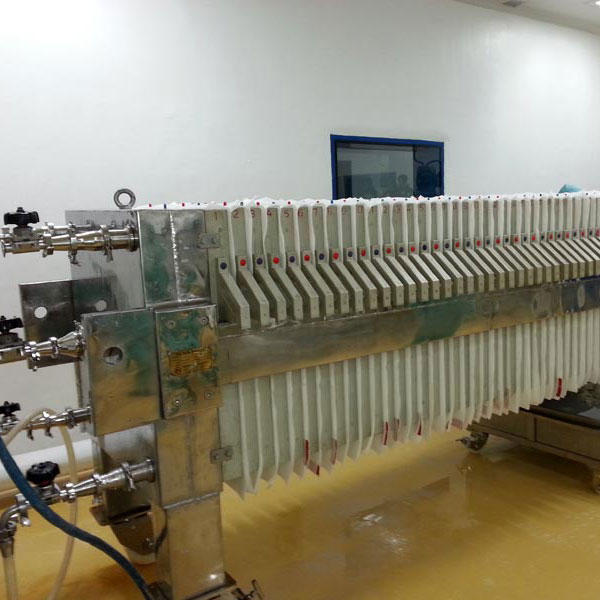
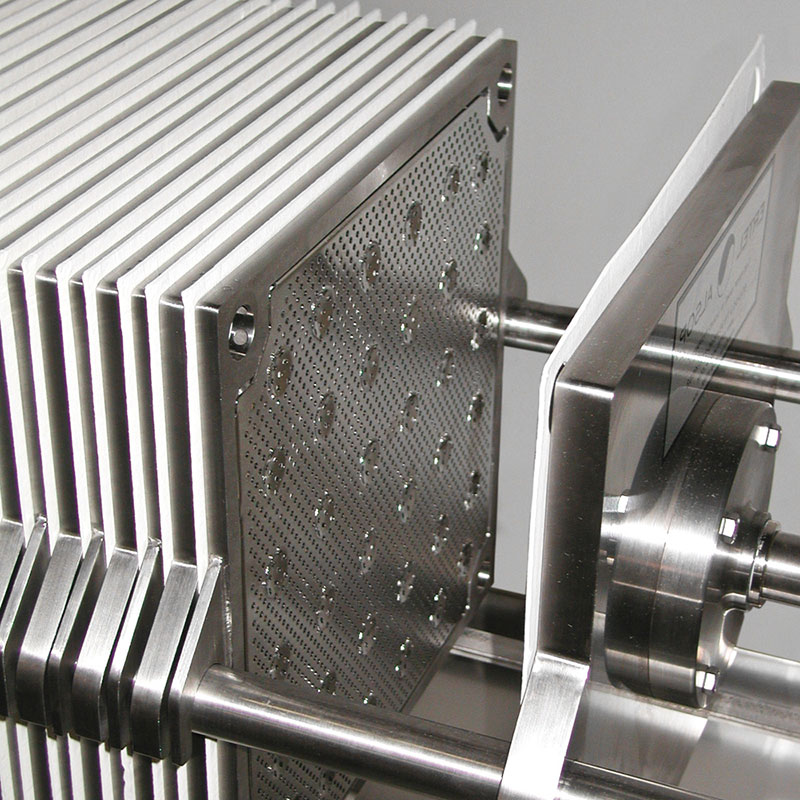
Filter presses are comprised of two fixed and one travelling heads. The travelling head serves to compress the plates. One fixed head is located near the hydraulic unit for compression of the plate, and the other is on the sludge intake structure.The plates are moved between two fixed heads with the help of shunts and beams located above. Each filtration plate is dressed with the filter cloth to cover both sides. When plates are lined side by side with the operation of the press, filtration cells in various plate numbers are formed.
The most commonly used plate is the center fed type. The feeding continues throughout the plates thus filling all chambers uniformly.
Discharge taps located at the bottom of the plates are one of the most widespread “Open Discharge” applications allowing the evacuation of filtrate to the desired place. Additionally, “Off Discharge” system is widely used for toxic, flammable and volatile filtrate.

Uses of Filter Press Units
Chemical Sector: In the painting industry; in the filtering process of intermediate products such as organic polymers, phosphoric acid soap and detergent, sodium silicate, latex,Food industry: For the filtering of products such as chocolate in the sugar industry, soft drinks, beer, malt, oil industry, pulp, wine, meat waste,
Ceramics Industry: In the dewatering of kaolin, clay, porcelain and glaze sludge,
Mining Sector: Copper, lead processes, recycling of precious metals such as gold and silver, the process of filtering coal preparation slurry
Metal Sector: Aluminum, galvanizing processes,
Electrolysis: the dewatering process of metal hydroxide sludge,
Water Treatment: Dewatering processes of municipal and industrial sludge in Water Treatment and Waste Water Treatment Plants, Marble Wastewater Treatment Plants.
An example to the operation of Filter Press Units
A marble factory was selected as an example to explain the operation of filter press units.Used water from the factory is collected in the waste water collection basin. Dirty water is pumped into a precipitation tank with a submersible pump and complete mixing is ensured at the precipitation line by injecting the amount of chemicals determined by the automatic dosing unit.
The puddle that forms a homogeneous mixture with chemicals inside the tank accumulates in the tapered portion of the tank through a vortex. With sludge accumulating in the tapered portion, supernatant clean water is transferred to a fresh water silo or other pool through sluices.
Sludge accumulated in the tapered parts is transferred to the sludge tank thanks to a pneumatic valve. Maintaining homogeneity in the slurry tank with an agitator running at a slow speed, sludge is pumped into the filter press with a slurry pump.
Adjusting the time setting according to wastewater flow of the marble factory, cake at the desired dryness is obtained at slow and then fast cycles.
With time setting adjusted from the Filter Presses control panel, the sludge dewatering process is completed within 5-15 mins.
Finally, the dewatered cake (sludge) exiting the filter press placed on a closed platform falls with the force of gravity on conveyors or a vehicle chassis. Water recycled through this system can be used in the plant or discharged.



PARTNERS
Our awesome partners we've had the pleasure to work with!